“The only lesson I learned, or at least the only lesson I remember, was you.”
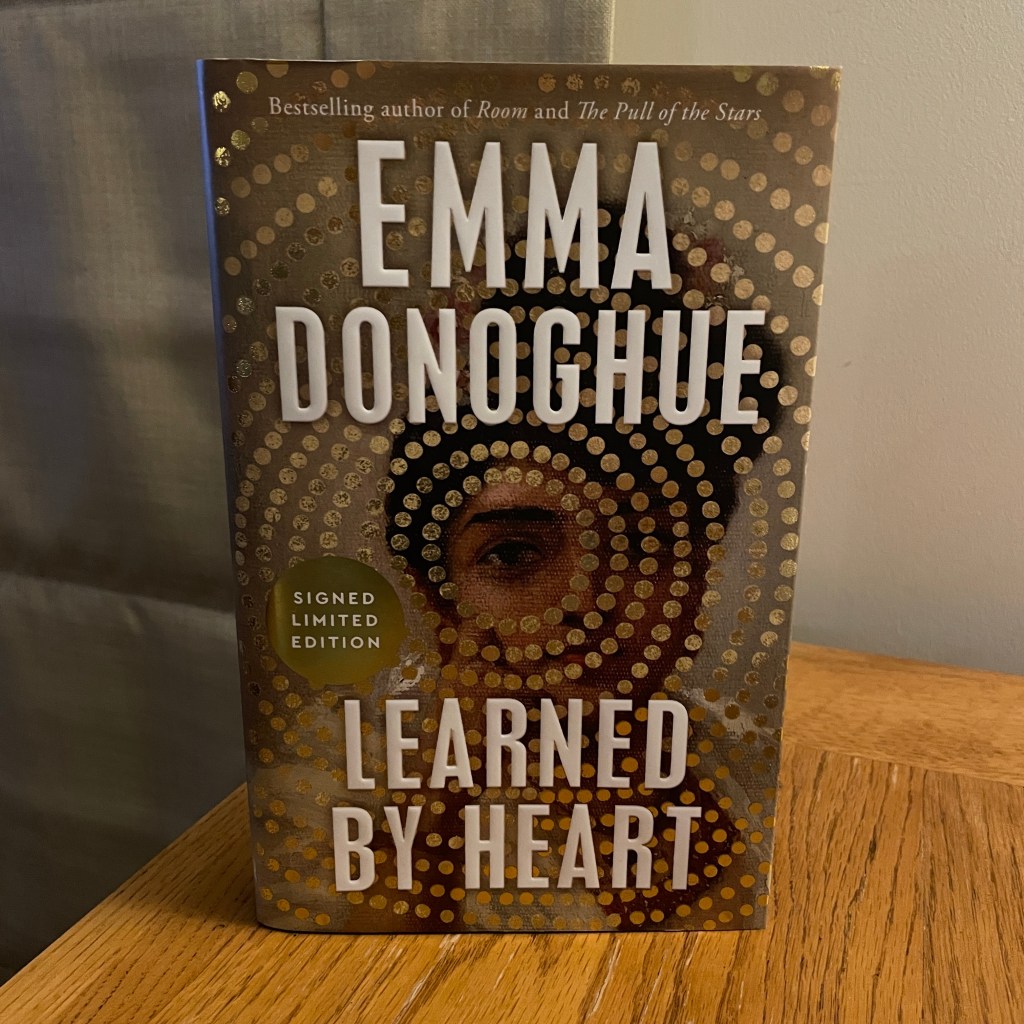
Emma Donoghue’s Learned by Heart is a poignant, intense and intricately-woven exploration of first love between Anne Lister and Eliza Raine, who share an attic room, known as ‘The Slope’, in their York boarding school.
Lister, an iconic businesswoman, landowner and diarist, is known to many readers from the BBC series ‘Gentleman Jack’. Eliza Raine was an orphan, born in Madras and forced to return to England.
Through Raine’s eyes, Lister is bright, bold and inquisitive – a maverick unafraid to challenge authority, and to do so loudly.
The intensity (and secrecy) of their connection is palpable, the claustrophobia mirroring the confines of their physical space.
Donoghue alternates the school narrative with Raine’s letters to Lister years later sent from her asylum. By this time, Raine is resentful, bitter and entreating by turns, lamenting the lost love and infusing the schoolgirls’ burgeoning relationship with poignancy.
While the historical detail and meticulous research is commendable and certainly enhanced the authenticity of the narrative, I felt it overwhelmed the narrative at times, at the expense of pace.
In spite of this, the novel is a compelling imagining of two girls in the first flushes of young love, learning their hearts and finding their feet. For Raine, that love endured beyond the confines of a boarding school attic.
It was an ending – the ending she yearned for all her life.
“For their sakes, show the world that people like you and they can be quite as selfless and fine as the rest of mankind. Let your life go to prove this — it would be a really great life-work, Stephen.”
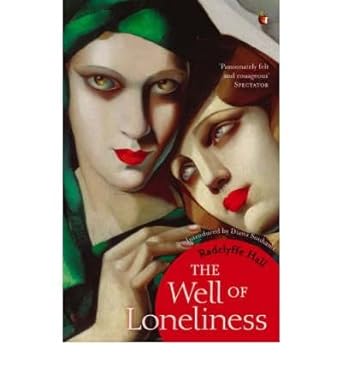
Radclyffe Hall’s The Well of Loneliness is regarded as part of the sapphic canon — an international bestseller, a seminal work of gay fiction and the predecessor of lesbian pulp fiction.
Despite the fact that the book is not sexually explicit, it became the subject of an obscenity trial in the UK upon publication in 1928, resulting in an order that all copies of the book be destroyed. (That alone is reason enough to wade through it, in my opinion.)
As Stephen King famously said, we need to go and find the banned books, the censored books. Find out what it is they’re so desperate to keep from us.
Fortunately for us all, Radclyffe’s novel survived the controversy and, for decades, was regarded as the most renowned work of lesbian literature.
Stephen Gordon is is the epitome of an ideal child born to aristocratic parents — a skilled fencer, a keen horse rider, and an able scholar. In youth, Stephen becomes a war hero and a celebrated writer. But… Stephen, named after the boy her parents wanted, is a woman. An “invert”, in her own words. And the novel, quite simply, is the story of her struggle.
Given the title, perhaps it goes without saying that this book is neither an easy or uplifting read. Virginia Woolf commented, “the dullness of the book is such that any indecency may lurk there — one simply can’t keep one’s eyes on the page”.
Did I enjoy reading it? No. Am I glad I have read it? Absolutely.
It isn’t, of course, a read that fits with modern sensibilities. But it is, I would argue, essential reading. It’s part of sapphic history — a courageous and important cultural artefact that paints a vulnerable, sympathetic portrayal of lesbians and bears crucial witness to attitudes of the time.
In spite of its critical reception and legal troubles, The Well of Loneliness did what all great books do — it reached people and gave them words of comfort and understanding.
Puddle, Stephen’s governess, puts it best:
“You’re neither unnatural, nor abominable, nor mad; you’re as much a part of what people call nature as anyone else; only you’re unexplained as yet — you’ve not got your niche in creation. But some day that will come, and meanwhile don’t shrink from yourself, but face yourself calmly and bravely. Have courage; do the best you can with your burden. But above all be honourable. Cling to your honour for the sake of those others who share the same burden. For their sakes show the world that people like you and they can be quite as selfless and fine as the rest of mankind. Let your life go to prove this — it would be a really great life-work, Stephen.”
And wasn’t it just. The Guardian reports that Radclyffe Hall received thousands of letters of support. In one such letter, a married coal miner from Doncaster writes to the novelist that he is dismayed by the bigotry of so-called ‘thinking men’. “Some day,” he says, “we will wake up, and demand to know ourselves as we profess to know about everything else”.
An uplifting, slow-burn YA f/f romance perfect for summer.
She Gets The Girl by Rachael Lippincott and Alyson Derrick
I don’t usually read rom-com or YA, but I’d heard Rachael Lippincott’s name a few times and decided to check this one out. Lippincott wrote this one with her wife, Alyson Derrick. I’m always intrigued by the process of two writers working together, and especially a wife-and-wife team!
She Gets The Girl features two girls meeting in their first year of college.
Alex is an independent, confident and flirty girl who wants to show her on-again-off-again girlfriend, Natalie, that she’s capable of commitment. But she has some stuff to figure out first, and some distance from Natalie – literal and figurative – might be exactly what she needs to do that.
Molly is painfully introverted and socially awkward. She is close to her family – her mom is her best friend – and can’t pluck up the courage to speak to her high school crush, Cora.
When the girls end up on the same college campus and Alex learns of Molly’s infatuation, she decides to help Molly get her girl, in an attempt to show Natalie that she can form meaningful connections without a vested interest. Alex convinces Molly to follow her five-step plan. Only problem is, she’s making it up as she goes along.
The natural relationship that evolves between the two main characters enables each to face and fight their demons in a story that is by turns hilarious, angsty and heartbreaking. The dialogue is full of banter, dry humour and plenty that’s left unsaid.
Whilst the book does feature darker topics – alcoholism and racism, to name but a few – the characters’ backstories are woven into the story in a way that was impactful without being heavy-handed.
The slow-burn, hate-to-love romance was well-paced, and the dual narrative worked beautifully. Each character has a distinct voice and seeing the same situation from their very different perspectives is a great source of humour in the book.
The outcome isn’t a surprise (the clue’s in the title) but this is a book you read for the journey, rather than the destination.
This is a light, uplifting book – the perfect addition to your sun lounger this summer.



 Victoria Brown