“I’m not here for prestige. I’m here for revenge.”
When We Were Silent is an immersive, powerful and moving debut from Fiona McPhillips.
Lou Manson is a working-class girl given a swimming scholarship to the prestigious Highfield school. Despite her precarious position as an outsider, Lou – both as girl and woman – is challenged to expose the school’s systemic grooming and abuse of the teenage girls in its care.
The book draws attention to the prevalence of abuse in Irish swimming during the 1980s, and sheds light on the failure of authorities to protect vulnerable children from sexual predators.
This was a difficult read at times – the book aches with agonising injustices, with the joy and energy and potential snuffed out. With the frustration of being young and powerless.
The righteous anger leaps from the page – and you can’t help but be infected with it – but whilst it is harrowing at times, the writing is always authentic and sensitive, never prurient or exploitative.
The empowerment of older women to defend their younger selves – and their peers – particularly resonated with me. Me too, me too, me too…
This is the kind of book you’ll want to press into the hands of everyone you know.
“The only lesson I learned, or at least the only lesson I remember, was you.”
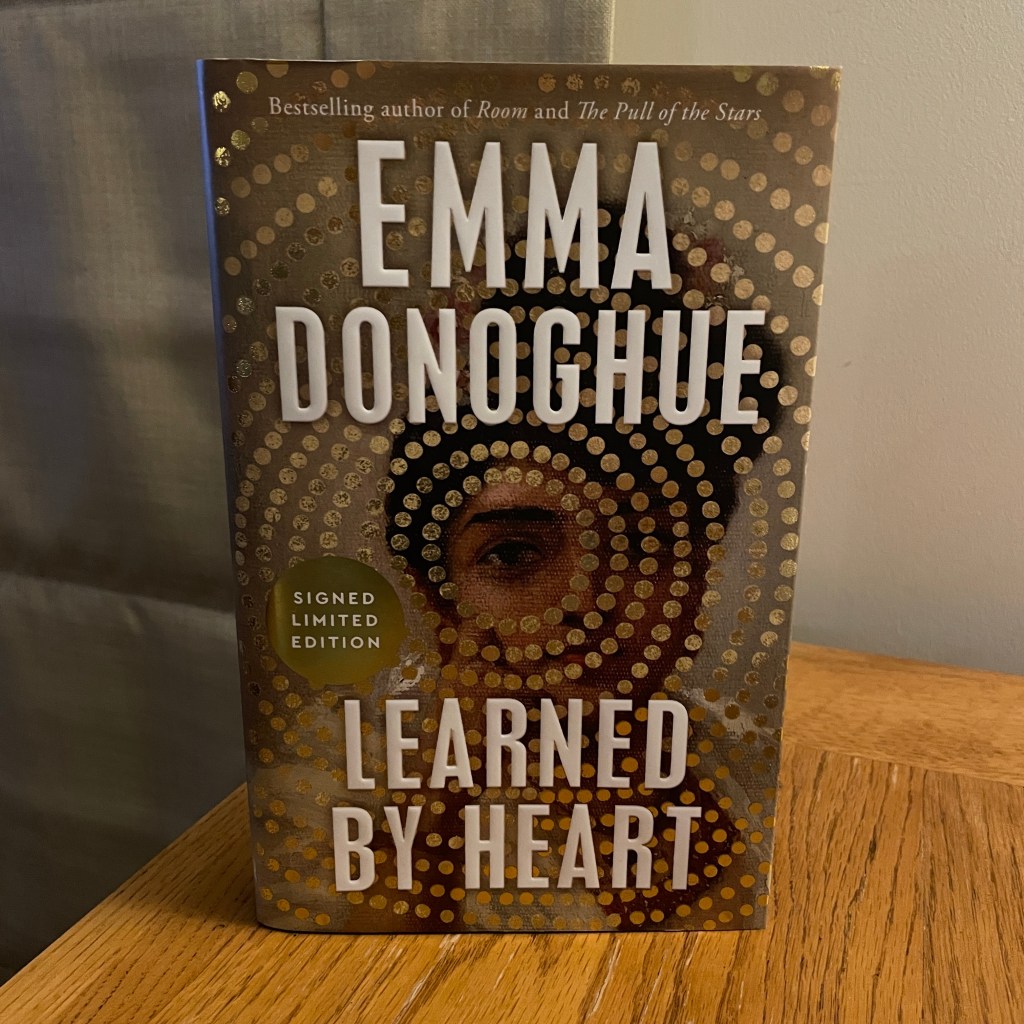
Emma Donoghue’s Learned by Heart is a poignant, intense and intricately-woven exploration of first love between Anne Lister and Eliza Raine, who share an attic room, known as ‘The Slope’, in their York boarding school.
Lister, an iconic businesswoman, landowner and diarist, is known to many readers from the BBC series ‘Gentleman Jack’. Eliza Raine was an orphan, born in Madras and forced to return to England.
Through Raine’s eyes, Lister is bright, bold and inquisitive – a maverick unafraid to challenge authority, and to do so loudly.
The intensity (and secrecy) of their connection is palpable, the claustrophobia mirroring the confines of their physical space.
Donoghue alternates the school narrative with Raine’s letters to Lister years later sent from her asylum. By this time, Raine is resentful, bitter and entreating by turns, lamenting the lost love and infusing the schoolgirls’ burgeoning relationship with poignancy.
While the historical detail and meticulous research is commendable and certainly enhanced the authenticity of the narrative, I felt it overwhelmed the narrative at times, at the expense of pace.
In spite of this, the novel is a compelling imagining of two girls in the first flushes of young love, learning their hearts and finding their feet. For Raine, that love endured beyond the confines of a boarding school attic.
It was an ending – the ending she yearned for all her life.
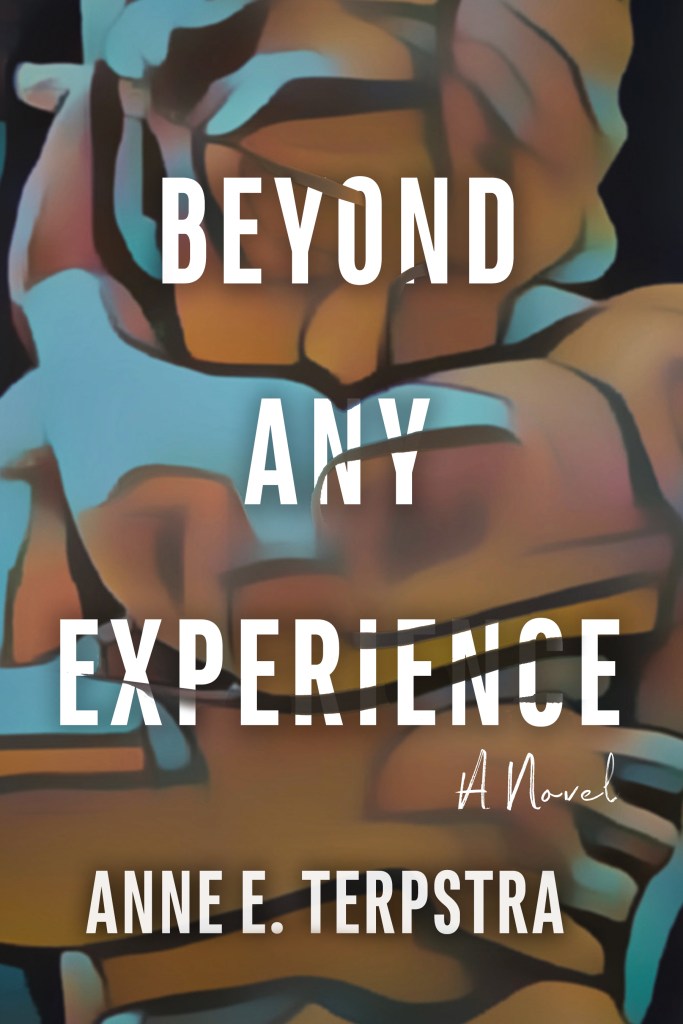
Anne E. Terpstra’s Beyond Any Experience is a love story that explores grief, intimacy and the difficulty of loving again after loss.
Olivia’s life is shattered when she loses her beloved wife, Sophia, in a tragic drink-driving accident. Now a single mother to her autistic son, Ben, Olivia grapples with the weight of her grief and the challenges of meeting Ben’s needs.
When Olivia crosses paths with Ellie, the latter makes no secret of her attraction. It was interesting to read a romance in which the characters fall for one another quickly, since most of the tension thereafter was in navigating the emotional complexities of their situation. Olivia is cautious and still reeling from her loss, and Olivia’s reticence fuels Ellie’s uncertainties and insecurities.
“Beyond Any Experience” is far from a straightforward, fairytale romance. The authenticity of the characters’ journey is testament to the author’s skill – the narrative never compromises on authenticity. The writing itself is beautifully crafted, drawing readers into the depths of Olivia and Ellie’s emotional worlds.
Jo Callaghan’s debut novel, “In The Blink of an Eye,” plunges readers into a gripping narrative that skilfully navigates the intersection of human intuition and artificial logic, raising profound questions about what it truly means to be human.
DCS Kat Frank, a seasoned detective grieving the loss of her husband, is chosen to lead a groundbreaking pilot program, partnering her with an AIDE (Artificially Intelligent Detective Entity) named Lock. Their mission: to delve into cold cases involving missing persons: cases that will expose the contrast between Kat’s well-honed instincts and Lock’s unyielding logic.
When, this book ask, is it appropriate to follow your gut, and when does a hunch risk bias and clouded judgment?
Kat Frank is sharp and unapologetically resistant to her AI companion, at least to begin with. Her initial disdain for Lock sets the stage for a fascinating evolution of their relationship which steals the spotlight from the cases themselves as the story unfolds.
As a refreshingly original debut, it’s no surprise that “In The Blink of an Eye” earned a place on Val McDermid’s ‘New Blood’ panel at Harrogate. The novel offers a glimpse into a future where we have to navigate the sometimes uneasy alliance of human and artificial intelligence, to find the best of both worlds.
“Tomorrow she could start again. Tomorrow she would make a plan. As she climbed the stairs to her own little room, the thoughts came rushing through her mind like autumn leaves kicked up by a fierce breeze, her initial wave of relief turning to worry.”
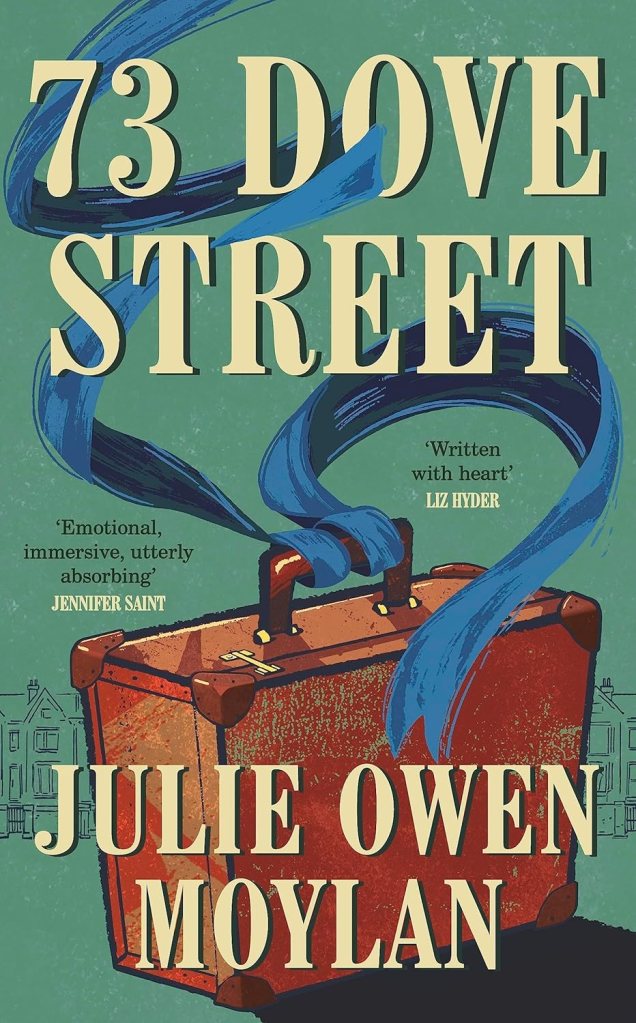
The author of ‘That Green Eyed Girl’ returns to work her magic again, bringing 1950s London alive in this compelling and evocative story of three ordinary women and their struggles.
When Edie Budd arrives at a run-down boarding house in the heart of West London in October 1958, she carries with her a battered suitcase, an envelope full of cash… and a secret that haunts her.
But Edie is not the only one at 73 Dove Street who is keeping secrets.
By day, fellow lodger, Tommie, works for the eccentric Mrs. Vee. By night, she succumbs to the allure of Soho’s shadowy nightlife and a relationship from which she can’t break free.
And Phyllis, 73 Dove Street’s formidable landlady, is broken by her husband’s betrayal.
You can rely on Julie Owen Moylan for an immersive read. She breathes life into her setting, transporting readers to every bar and side street of this bygone era.
The three characters’ stories are delicately interwoven and moving without ever veering into melodrama, testament to the author’s skill in balancing emotional depth and resonance with authenticity.
Edie’s story in particular is beautifully unravelled and resolved, with the pacing and tension pitch perfect to keep you turning those pages.
Another exceptional read, “73 Dove Street” showcases Julie Owen Moylan’s talent for crafting immersive and authentic historical fiction.
“For their sakes, show the world that people like you and they can be quite as selfless and fine as the rest of mankind. Let your life go to prove this — it would be a really great life-work, Stephen.”
Radclyffe Hall’s The Well of Loneliness is regarded as part of the sapphic canon — an international bestseller, a seminal work of gay fiction and the predecessor of lesbian pulp fiction.
Despite the fact that the book is not sexually explicit, it became the subject of an obscenity trial in the UK upon publication in 1928, resulting in an order that all copies of the book be destroyed. (That alone is reason enough to wade through it, in my opinion.)
As Stephen King famously said, we need to go and find the banned books, the censored books. Find out what it is they’re so desperate to keep from us.
Fortunately for us all, Radclyffe’s novel survived the controversy and, for decades, was regarded as the most renowned work of lesbian literature.
Stephen Gordon is is the epitome of an ideal child born to aristocratic parents — a skilled fencer, a keen horse rider, and an able scholar. In youth, Stephen becomes a war hero and a celebrated writer. But… Stephen, named after the boy her parents wanted, is a woman. An “invert”, in her own words. And the novel, quite simply, is the story of her struggle.
Given the title, perhaps it goes without saying that this book is neither an easy or uplifting read. Virginia Woolf commented, “the dullness of the book is such that any indecency may lurk there — one simply can’t keep one’s eyes on the page”.
Did I enjoy reading it? No. Am I glad I have read it? Absolutely.
It isn’t, of course, a read that fits with modern sensibilities. But it is, I would argue, essential reading. It’s part of sapphic history — a courageous and important cultural artefact that paints a vulnerable, sympathetic portrayal of lesbians and bears crucial witness to attitudes of the time.
In spite of its critical reception and legal troubles, The Well of Loneliness did what all great books do — it reached people and gave them words of comfort and understanding.
Puddle, Stephen’s governess, puts it best:
“You’re neither unnatural, nor abominable, nor mad; you’re as much a part of what people call nature as anyone else; only you’re unexplained as yet — you’ve not got your niche in creation. But some day that will come, and meanwhile don’t shrink from yourself, but face yourself calmly and bravely. Have courage; do the best you can with your burden. But above all be honourable. Cling to your honour for the sake of those others who share the same burden. For their sakes show the world that people like you and they can be quite as selfless and fine as the rest of mankind. Let your life go to prove this — it would be a really great life-work, Stephen.”
And wasn’t it just. The Guardian reports that Radclyffe Hall received thousands of letters of support. In one such letter, a married coal miner from Doncaster writes to the novelist that he is dismayed by the bigotry of so-called ‘thinking men’. “Some day,” he says, “we will wake up, and demand to know ourselves as we profess to know about everything else”.
“The Short Straw” by Holly Seddon has all the quintessential elements of a spooky mystery — an old manor house full of secrets and things that go bump in the night… And three sisters stranded there.
When their car breaks down in the midst of a storm, sisters Nina, Lizzie and Aisa seek refuge at Moirthwaite Manor — their mother’s former place of work, and one full of childhood memories. Now the imposing old house is now abandoned and desolate.
There’s only one way to decide who should venture out into the darkness for help… They draw straws, just like they did when they were kids.
One sister disappears into the night, leaving the others separated within the eerie manor house. As the story unfolds, the deadly secrets concealed within the house finally emerge, revealing the unspeakable bond that ties the family together.
“The Short Straw” is a masterclass in characterisation. From the practical Nina to the timid Lizzie to wild Aisa, each of the sisters is shaped by their place in the family, and their complex relationships feel truly authentic.
The book is sinister and intense, well-paced and chock full of heart-pounding moments to keep you turning the pages. (I heartily recommend you don’t listen to this on audiobook in the dark, like I did, although the narration is wonderful too!)
Dark, unsettling and atmospheric, “The Short Straw” is a fantastic blend of family drama, suspense, mystery and tragedy, woven together with superb storytelling — a must-read for fans of psychological thrillers and spooky mysteries.
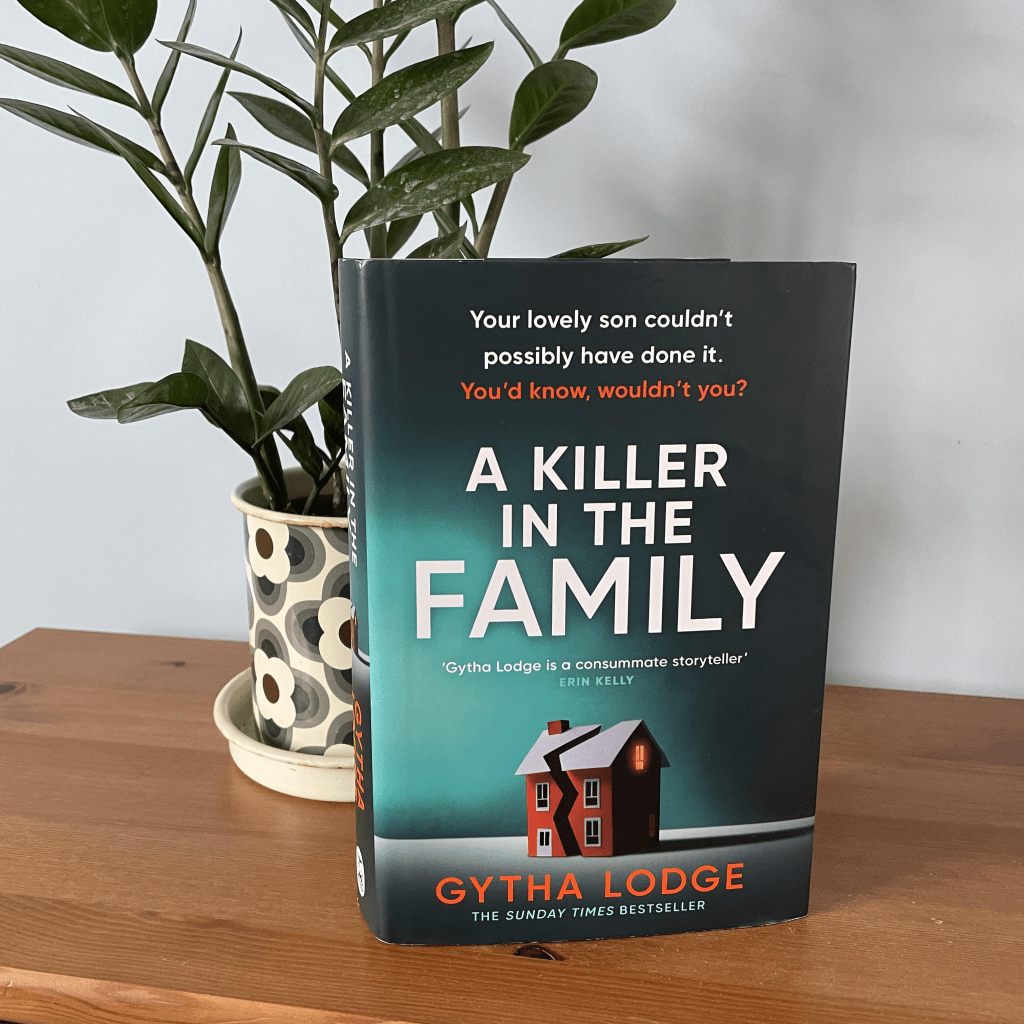
What if you uploaded your DNA online, but instead of finding your estranged father, you open the door to police? And they tell you that either your father or one of your sons is a murderer?
“A Killer in the Family” is the fifth book in Gytha Lodge‘s Jonah Sheens series – a gripping and thought-provoking read that centres around the subject of DNA ancestry testing and the unsettling secrets it can unearth.
The infamous ‘Bonfire Killer’ is on a spree, causing widespread panic. Constant vigilance is advised and women are not to travel alone at night. When Aisling Cooley discovers that her DNA has been discovered at a recent crime scene, the implication is clear. Either her estranged father or one of her two beloved sons, Ethan and Finn, must be the serial killer.
Gytha brings her trademark blend of original concept, meticulous research and compelling characterisation to this latest book in the series, which delves into the complexities of relationships, the bounds of family loyalty and the moral questions surrounding the use of DNA in the context of criminal investigations.
From detective to victim – and everything in between – each character leaps off the page: real, rounded and relatable. The writing is smart and beautifully crafted, as always, and the twists and turns are deftly done to keep you guessing until the final pages.
Gytha continues to develop captivating storylines for Jonah and his team, with their often-messy personal lives becoming intertwined with their police work. Quite honestly, I’d read the series for this team alone!
So… if you’re looking for a fantastic group of flawed but lovable detectives, and a compelling read that makes you think, look no further!
Thank you to Gytha and Michael Joseph for a gorgeous ARC of this book.
No Life for a Lady by Hannah Dolby is an engaging and heart-warming read that transports the reader to 1896 Hastings and offers the kind of escapism reading is all about.
Still unmarried at the grand old age of twenty-eight, Violet Hamilton has frustrated her father by rejecting countless suitors. She believes there must be more to life than marriage, and is in hot pursuit of her own purpose… whatever that may be.
If that weren’t enough to risk her reputation, Violet is determined to investigate the disappearance of her mother from Hastings Pier ten years prior. On enlisting the services of a detective named Mr. Knight, Violet soon discovers that the man is not what he claims to be.
Enter Benjamin Blackthorn, the bearded son of Hasting’s finest detective, who only wants a quiet life selling furniture. Not if Violet has anything to do with it!
Violet Hamilton is likeable, determined and prone to frequent mishaps… in short, everything you want in a heroine!
I was wholly engrossed in her world as she set about solving the mystery of her disappearing mother and finding her own way in the world. The adventure manages to be sweet but not saccharine, heart-warming but not twee and full of humour which frequently crescendo to moments of utter hilarity.
The only downside was that I did guess the book’s secrets fairly early on, but that didn’t spoil my enjoyment of the story.
This was a funny, poignant and redemptive story. I think it’s certain to be a hit with fans of A. J. Pearce and will look out for more from Hannah Dolby in future.
Every now and again, a book comes along that changes the game for the whole genre.
Wrong Place Wrong Time by Gillian McAllister is one such book.
One night, Jen Brotherhood witnesses something dreadful: her beloved teenage son killing a stranger outside their house. She doesn’t know why or who the man is, all she knows is that’ Todd’s future is over.
But when Jen wakes up the next morning, it’s the day before and the murder hasn’t yet happened. Every morning, Jen travels back in time. Is she being given a chance to play detective and stop the murder in its tracks?
This book is a Sunday Times and New York Times bestseller and Reese’s book club pick, and it’s easy to see why.
It’s a masterclass in plotting – although we’re going backwards, information is revealed and clues seeded meticulously. Every time you think you’re one step ahead, everything you thought you knew is thrown up in the air all over again. The physics was obviously carefully researched and manages to be mind-blowing without being too heavy-going.
And if that weren’t enough, it’s a beautiful, heartrending portrait of motherhood, guilt, regret and righting past wrongs. The writing is like melted butter.
This book absolutely deserves every accolade.
This was my first Gillian McAllister… and it certainly won’t be my last!
If you like clever thrillers with plenty of heart, and you pride yourself in figuring out the ending, look no further!







 Victoria Brown